

PRINTABLES:
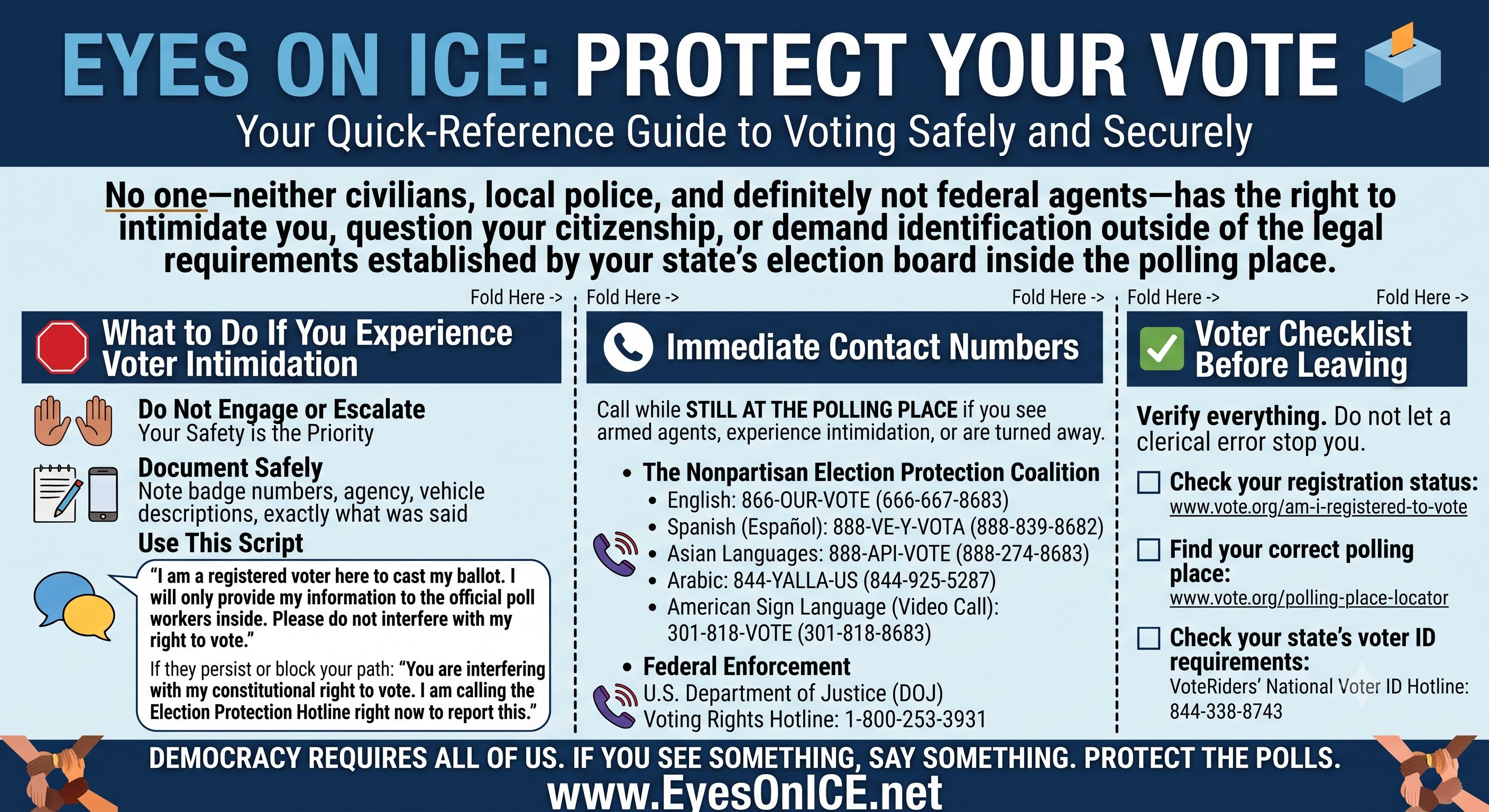
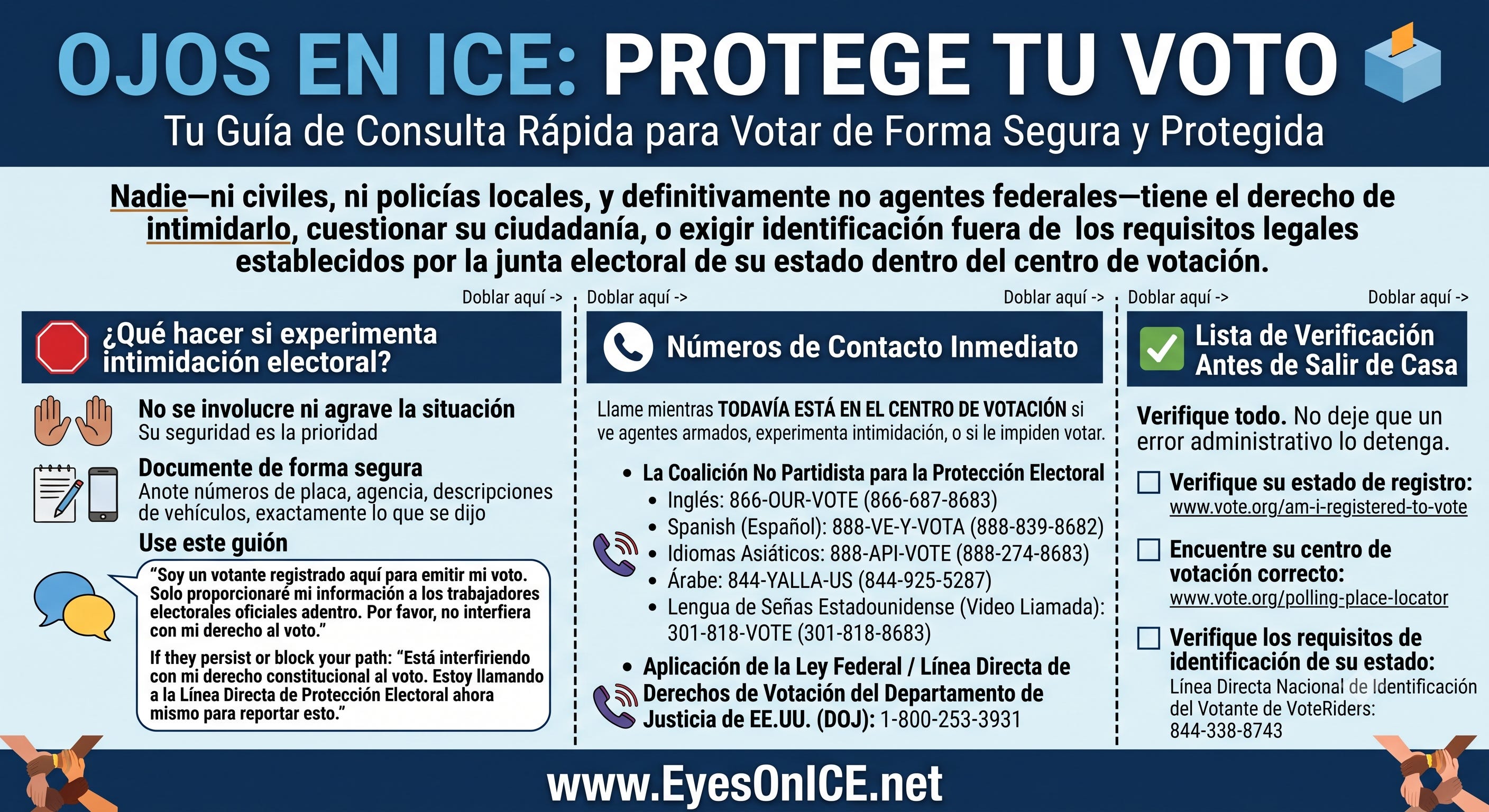
When asked recently if he would deploy the National Guard or ICE to voting locations this November, Donald Trump refused to rule it out, stating he would do “anything necessary” to ensure “honest elections.”
The visual of armed federal agents or immigration enforcement stationed outside local community centers and schools is undeniably chilling. But beyond the immediate intimidation factor, it is critical to understand the legal reality: Deploying federal troops or armed agents to polling locations is explicitly prohibited by federal law.
When political rhetoric attempts to normalize the militarization of our polling places, community defense requires knowing exactly where the legal boundaries are drawn.
The Anatomy of Voter Intimidation: What the Law Actually Says
The suggestion that federal agents could be used as localized poll watchers completely ignores over a century of established legal protections. There are strict, codified limitations on what federal and military personnel can do anywhere near an election.
Here is exactly why these proposed deployments violate federal statute:
Troops at Polls (18 U.S.C. § 592): It is a federal crime for any officer of the military or civil service of the United States to order, bring, or control any troops or armed men at a general or special election location. The only exception to this statute is if force is explicitly necessary to repel armed enemies of the United States.
Interference by Armed Forces (18 U.S.C. § 593): Any member of the Armed Forces who attempts to prevent qualified voters from exercising their right to vote by force, threat, or intimidation faces up to five years in prison and disqualification from holding federal office.
General Voter Intimidation (52 U.S.C. § 10307 & 18 U.S.C. § 594): Federal law broadly prohibits anyone, whether acting under the color of law or otherwise, from intimidating, threatening, or coercing any person for voting or attempting to vote.
As Jonathan Diaz of The Campaign Legal Center notes in the clip, the only people who belong at a polling place are eligible voters. The strategic intent behind floating the idea of ICE or the National Guard at polling sites is, as David Becker from the Center for Election Innovation and Research points out, to make targeted demographics feel inherently unsafe.
If You See Something, Say Something: How to Protect the Polls
Our democracy only functions when we actively participate and refuse to be bullied out of our constitutional rights. As Louis Bedford of the Legal Defense Fund (LDF) emphasizes, tackling this issue requires collective community action. We cannot let intimidation tactics go unchallenged.
If you witness any unauthorized armed presence, strange surveillance, or direct intimidation at your polling place, do not engage them directly. Document what you safely can, and immediately report the incident.
Immediate Election Protection Hotlines:
English: Call 866-OUR-VOTE (866-687-8683).
Spanish (Español): Call 888-VE-Y-VOTA (888-839-8682).
Arabic: Call 844-YALLA-US (844-925-5287).
Asian Languages: Call 888-API-VOTE (888-274-8683).
Action Steps: Verify Your Status Before Election Day
Do not wait until November to ensure your legal right to cast a ballot is secure. System purges and bureaucratic errors happen.
Check Your Registration: You can verify your voter registration status securely in under a minute at Vote.org.
Register or Update: If you have moved, changed your name, or your state has purged your registration, use Vote.org’s registration tools to re-submit your information.
Protect each other. Keep your eyes open. Do not let them operate in the shadows.
🗳️ Essential Voter Resources & Legal Citations
Know Your Voting Rights (Video Guides)
English: ACLU - Know Your Voting Rights at the Polls
English: ACLU - Your Vote, Your Voice: Know Your Rights
Español: ACLU - Conozca Sus Derechos de Voto
Where to Report Voter Intimidation
If you or anyone you know experiences intimidation at the polls, do not wait. Immediately contact the nonpartisan Election Protection Coalition:
English: 866-OUR-VOTE (866-687-8683) | 866ourvote.org
Spanish / Español: 888-VE-Y-VOTA (888-839-8682) | naleo.org
Asian Languages: 888-API-VOTE (888-274-8683) | apiavote.org
Arabic: 844-YALLA-US (844-925-5287) | yallavote.org
U.S. Department of Justice Voting Rights Hotline: 800-253-3931 | civilrights.justice.gov
Check Your Registration & How to Vote
Check Voter Registration Status: Vote.org/am-i-registered-to-vote
Register to Vote: Vote.org/register-to-vote
Find Your Polling Place: Vote.org/polling-place-locator
Source Citations & Expanded Legal References


