

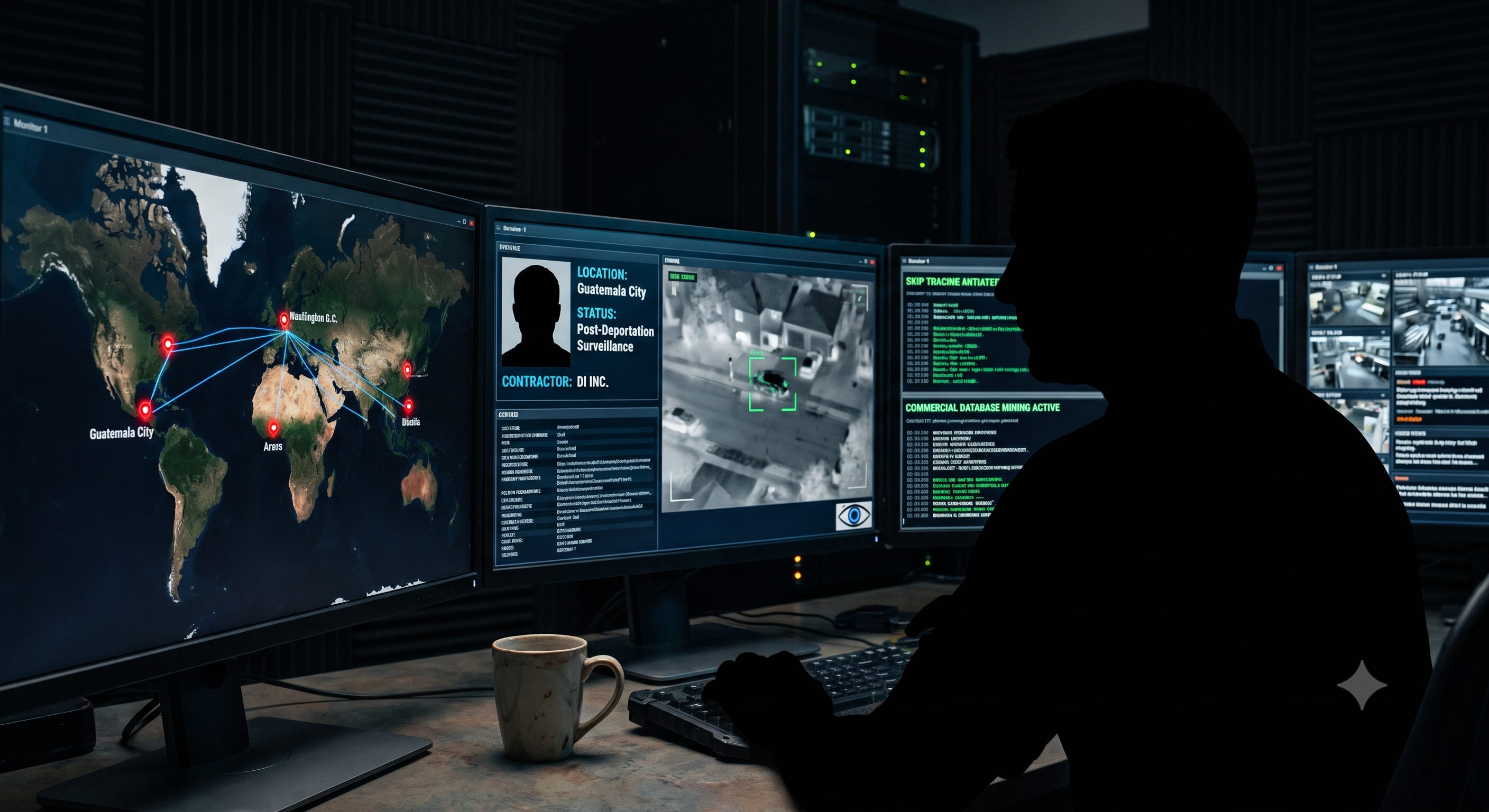
The Department of Homeland Security (DHS) and U.S. Immigration and Customs Enforcement (ICE) have established a massive, privatized surveillance apparatus designed to track and observe migrants. As highlighted by a recent Wired report—titled “DHS Is Hiring Bounty Hunters to Find and Photograph Deported People’s Homes Abroad”—this initiative involves paying private contractors to track individuals even after they have left the United States, utilizing physical surveillance to photograph their homes and workplaces abroad.
This global tracking effort is corroborated by the ice_skip_tracing_dossier.pdf file, which outlines a multi-million-dollar program utilizing defense, intelligence, and private security firms as an outsourced “force multiplier” for ICE’s Enforcement & Removal Operations (ERO).
The $281 Million Skip Tracing Network
In December 2025, ICE awarded 13 single-award Indefinite Delivery/Indefinite Quantity (IDIQ) contracts under Solicitation 26-SOL-DCR-01. The program operates with a combined ceiling of approximately $281 million and has a period of performance extending through December 2027.
To locate individuals on the non-detained docket, these contracted companies utilize a blend of surveillance techniques, including:
Processing government-furnished case data.
Conducting commercial data verification and database mining.
Utilizing automated digital research tools.
Performing physical observation and surveillance.
The Contractors: From Prison Operators to Military Intelligence
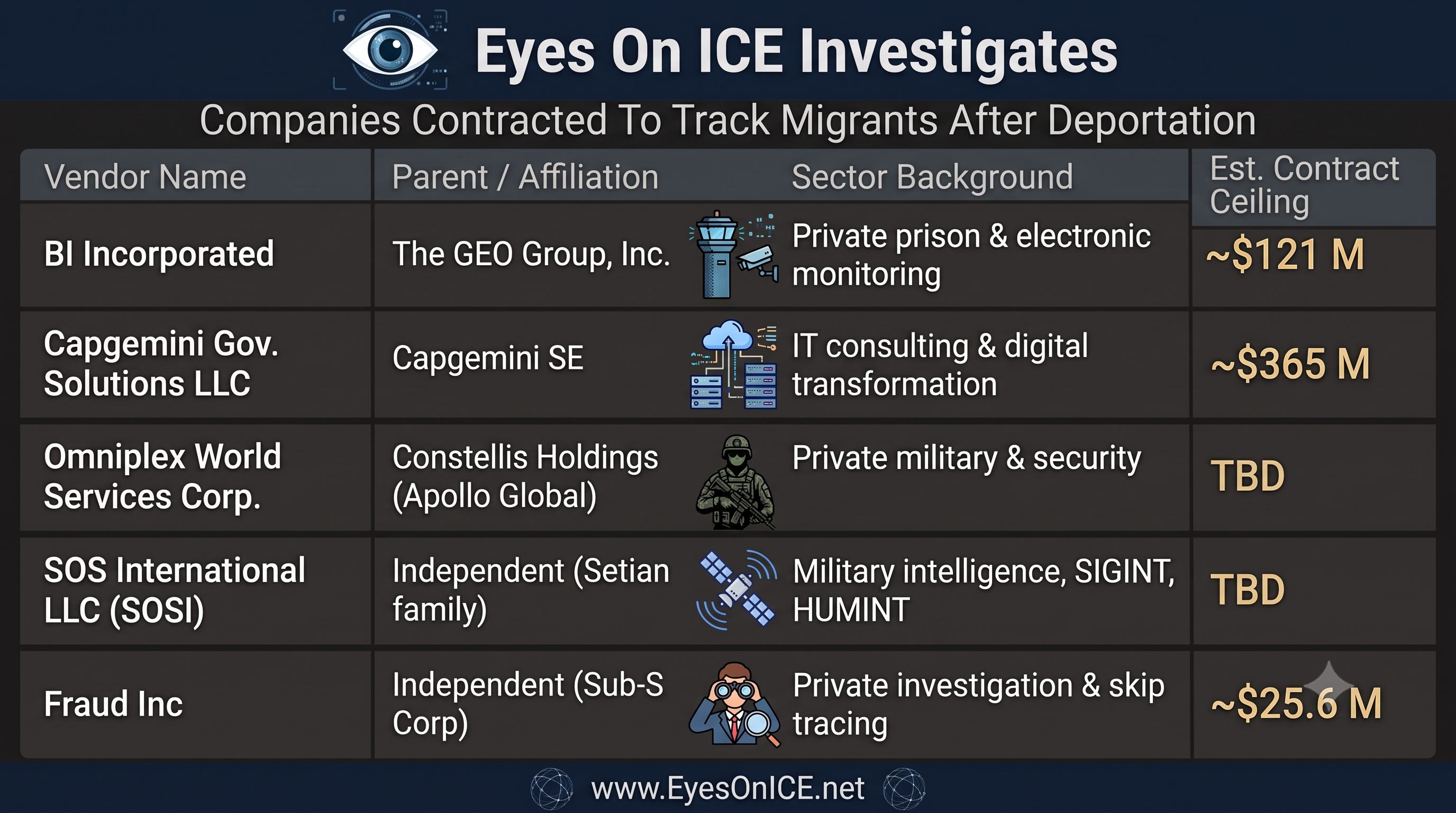
The 13 vendors awarded these contracts range from intelligence boutiques to massive private military corporations. The table below outlines several of the most prominent entities participating in this network:
Beyond their baseline capabilities, the corporate histories of these vendors reveal deep ties to national security and localized law enforcement:
BI Incorporated: As a wholly-owned subsidiary of The GEO Group, Inc., this firm already manages ICE’s electronic ankle-monitoring contract. The skip-tracing program serves as a direct expansion of their existing surveillance reach. Approximately $19 million has already been obligated to them to date.
Capgemini Government Solutions LLC: Despite holding the largest estimated ceiling, parent company Capgemini SE announced a divestiture of this unit effective February 2026. This decision followed intense public pressure and French parliamentary inquiries sparked by fatal ICE-related shootings in Minneapolis.
Omniplex World Services Corp.: This vendor shares a corporate lineage with private military contractors Triple Canopy and Centerra, which operate under the Blackwater/Academi umbrella.
SOS International LLC (SOSi) & Bluehawk LLC: Both firms are rooted in the military and intelligence communities, bringing capabilities in Signals Intelligence (SIGINT), Human Intelligence (HUMINT), and cyber defense to ICE’s disposal.
Incentivizing Surveillance and Civil Rights Backlash
The strategy of paying private firms to hunt down and photograph migrants—frequently characterized by critics as a “bounty hunter” system—has sparked significant controversy. The program utilizes financial incentive structures to encourage contractors to rapidly verify locations and serve official documents.
This profit-driven approach to immigration enforcement has drawn intense scrutiny from civil rights organizations, the Electronic Frontier Foundation (EFF), and academic watchdogs. Critics have raised alarms over the privatization of surveillance, data privacy violations, and the ethical implications of financial incentives that turn human lives into targeted quotas. The resulting public pressure has already caused fractures in the contractor network, most notably with Capgemini’s high-profile corporate withdrawal from the program in early 2026.
By combining commercial data brokers, military-grade intelligence gathering, and on-the-ground physical surveillance both domestically and abroad, DHS has built an unprecedented tracking system. As these private vendors continue to execute task orders through 2027, the expansion of ICE’s reach promises to keep the intersection of private profit and government surveillance under a harsh public spotlight.
Here is a list of the sources, databases, and reference materials cited within the provided vendor dossier:
USAspending.gov, utilized for real-time task order obligation tracking and award searches.
SAM.gov (System for Award Management), used as the authoritative source for verifying entity information and Unique Entity Identifiers (UEIs).
Federal Procurement Data System (FPDS), used for tracking the solicitation ‘26-SOL-DCR-01’.
HigherGov.
GovTribe.
Corporate filings, specifically SEC filings associated with The GEO Group.
Corporate press releases.
The Washington Post.
The Guardian.
Government Accountability Office (GAO) bid protest decisions, explicitly citing File No. B-424186.3 regarding the challenge by Ballard Green, LLC.
Freedom of Information Act (FOIA)-based tracking reports published by the Electronic Frontier Foundation (EFF).
Reporting and scrutiny from civil rights organizations and academic watchdogs.


