


The Irish did not arrive in America as honorary whites. They arrived as a problem. As a threat. As bodies to be contained.
They were called filthy. Violent. Subhuman.
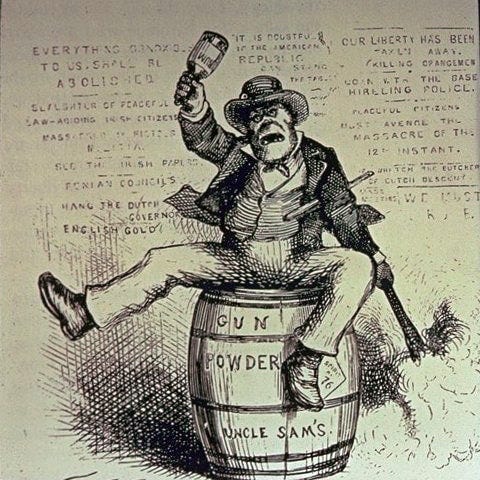
“The Usual Irish Way of Doing Things” by Thomas Nast (1871)
They were compared to apes in newspapers.
They were barred from jobs with signs that read “No Irish Need Apply.” They were treated as a racial underclass, shoved into slums, and policed as if their existence itself was a crime. Their Catholicism was framed as foreign contamination. Their hunger was mocked. Their grief was entertainment.
They were placed in the same category of undesirables as Black people, Jewish people, and Native people. Different histories and different wounds, but the same American instinct remains. Find a group, strip its humanity, and build a hierarchy on the bones.
The Irish were told they were not fit for citizenship. Not fit for decency. Not fit for belonging. And the country that caged them then has not forgotten how to cage now. The old machinery of othering never rusted. It simply changed targets.
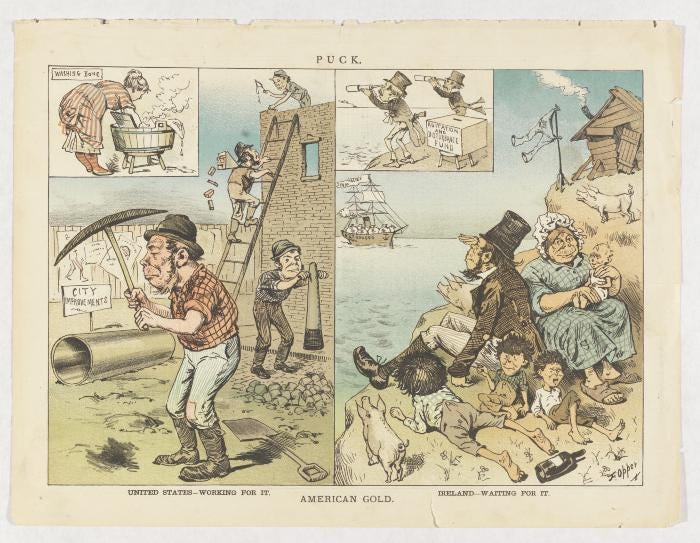
“American Gold,” Puck, May 24, 1882.
THE PIVOT INTO THE PRESENT

Camp East Montana/Fort Bliss Detention Center
From inside an ICE facility in El Paso, Texas, specifically the Camp East Montana tent city, an Irish man named Seamus Culleton sends a signal that demands attention.
He proclaims it to be a “modern-day concentration camp.”
The words land heavy. Not metaphor. Not exaggeration. A warning.
Culleton has been held for months. His report is not a complaint. It is a field note from inside the machine.
He describes a ritual of confinement designed to grind down the human spirit. Crowded tents. Filth. Uncertainty. “I’m treated like a dog, he says. The sentence is simple. The meaning is not.
And here is the creature-logic of it all. The Irish once lived under the same architecture of suspicion. They were once the bodies America decided were disposable.
The system remembers that old song. It knows the melody of exclusion by heart. It plays it again now, on a new station, for anyone caught in its teeth.
Historical Context & Citations
The “Simian” Caricature:
Image Source: “The Usual Irish Way of Doing Things” by Thomas Nast (Harper’s Weekly, 1871).
Analysis: “Irish Apes: Tactics of De-Humanization” – The Society Pages.
Employment Discrimination (NINA):
Primary Source: “No Irish Need Apply” – Evidence of NINA signs and advertisements in 19th-century newspapers (The New York Times / Oxford Journal of Social History).
Article: “When America Despised the Irish: The 19th Century’s Refugee Crisis” – History.com.
The “White Negro” & Racial Hierarchy:
Source: “How the Irish Became White” – Discussion of Noel Ignatiev’s historical analysis of the Irish racial transition.
Cartoon: “American Gold” (Puck Magazine, 1882) – Depicting the Irish filling the almshouses and prisons.
Current Context: Camp East Montana / Fort Bliss
Conditions at Fort Bliss (The “Tent City”):
Investigative Report: “Fort Bliss Migrant Shelter: Whistleblowers Describe ‘Cover-Up’” – BBC News (Documenting the conditions, filth, and overcrowding that form the basis of the “concentration camp” comparison).
Legal Filing: “‘Grossly Inadequate’: Conditions for Migrant Children at Fort Bliss” – The Texas Tribune (Detailing the mental health crisis and “animal-like” treatment inside the facility).


