

Eyes On ICE Investigates: The Logistical Paradox
Strategic Contextualization
Since early 2025, United States immigration policy has undergone a fundamental doctrinal shift, moving away from routine border returns toward a high tempo strategy of third country removals. The Department of Homeland Security has effectively weaponized logistical inefficiency to signal political resolve. By bypassing Mexico, a country both willing and legally obligated to receive its citizens, the administration has prioritized strategic signaling over budgetary restraint. Investigating this operational pivot is essential to understanding how deportation has been transformed from an administrative function into a resource intensive tool of statecraft.
Episode Overview
This episode dissects the Logistical Paradox at the heart of current enforcement: the deliberate choice to ignore the most efficient repatriation route. Despite the Mexican Foreign Ministry explicit readiness to accept its nationals, the United States has executed over 23,000 third country transfers to Guatemala and Honduras. We examine why the U.S. government views a high cost, indirect route as a superior strategic asset compared to standard bilateral cooperation.
The Paradox of Choice: Analytical Data
The strategic calculus behind this policy hinges on the rejection of Mexican sovereignty in favor of national security signaling. DHS has opted for an operationally complex alternative that requires significant bilateral activation and the use of military assets.
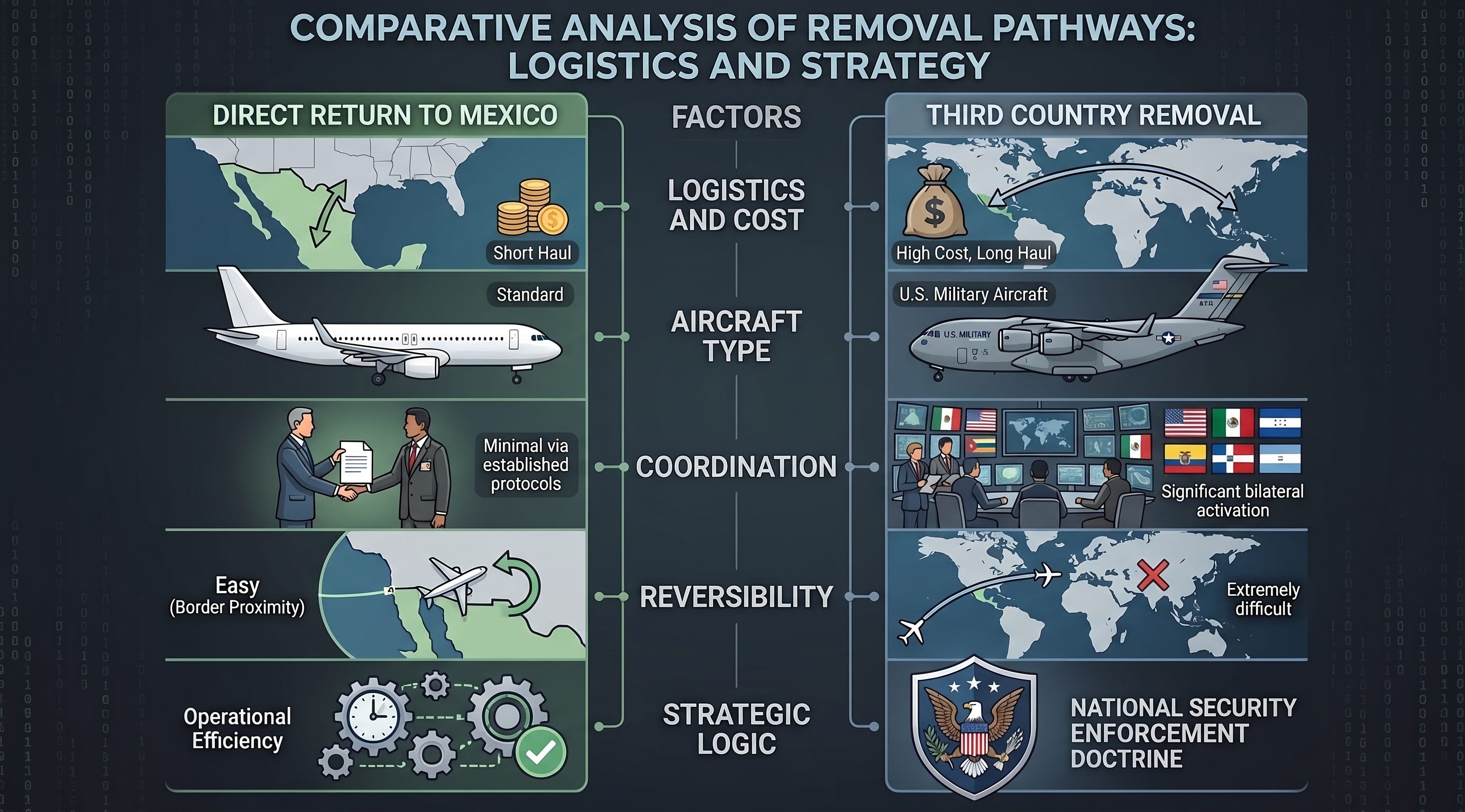
Flight Telemetry and Strategic Inefficiency
The absurdity of this logistical path is highlighted by the flight telemetry. To avoid Mexican cooperation, these flights must traverse or circumnavigate the entirety of Mexican airspace. They often skirt the territory via expensive Gulf of Mexico or Caribbean routes. This inefficiency is a feature, not a bug. By utilizing military aircraft for these long haul operations, the administration frames immigration as a national security priority where the political deterrent value outweighs the fiscal burden.
Resource References
Jama v. ICE (2005): The Supreme Court precedent utilized to justify the removal of a noncitizen without the advance consent of the destination country’s government.
Mexican Foreign Ministry Statements: Official registry of rejections regarding third country transfers, affirming that Mexico accepts the return of all its nationals and has no third country agreements in place.
Connective Tissue
By making the physical journey home a multi country ordeal, the logistical burden of the flight serves as the foundation for the psychological deterrence explored in the next episode.
U.S. deporting Mexican migrants to Guatemala and Honduras
This broadcast corroborates the operational strategy of routing deportation flights around Mexican territory to deposit Mexican citizens further south as a targeted deterrence measure.


