
The Guardrail Guy Was Just Silenced And We Need to Stop Pretending Otherwise
08.03.2026

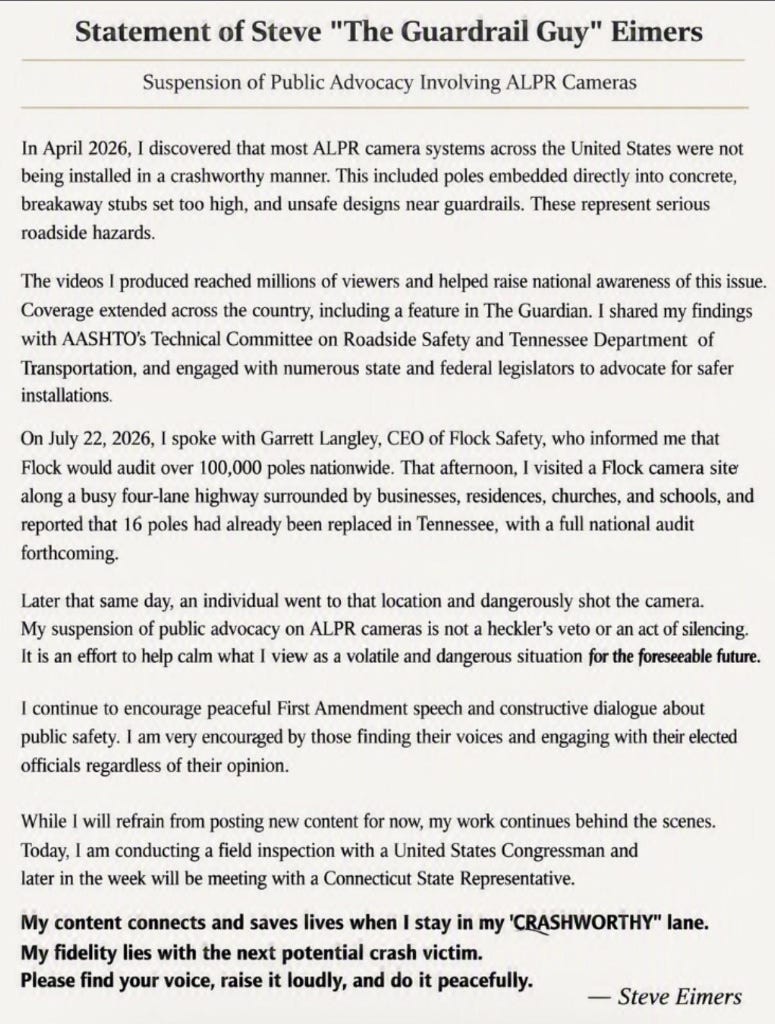
Steve Eimers can be as polite as he wants in his public statement. He can insist that walking away from his campaign on Automated License Plate Reader (ALPR) cameras is “not a heckler’s veto or an act of silencing.”
But let’s be honest about what just happened: The Guardrail Guy has been silenced.
When an independent, public-facing investigator spends months exposing roadside safety hazards, forces a national corporate audit of over 100,000 camera poles, and then suddenly has to stop posting because someone opened fire on a site he just inspected—that is the definition of a heckler’s veto. Whether the muzzle comes from a courtroom injunction, corporate attorneys, or the threat of unpredictable street violence, the result is the exact same. A critical voice for public safety and accountability has been pushed off the air.
How a Highway Safety Issue Turned Volatile
Eimers didn’t wade into the ALPR debate to argue about Fourth Amendment surveillance or data retention. He looked at the cameras through one specific lens: roadside crash survivability.
Back in April 2026, he started documenting a nationwide pattern of sloppy, dangerous camera installations:
Rigid concrete embeds that don’t give way when a car hits them.
Breakaway stubs installed too high, turning them into steel spears that can rip through a vehicle’s undercarriage or cabin.
Bad placement near guardrail terminals, disabling the safety barriers that are supposed to save lives.
His independent fieldwork caught fire. The videos reached millions of people, earned a feature in The Guardian, and got the attention of state DOTs and federal lawmakers. By July 22, the pressure campaign forced a massive concession: Garrett Langley, the CEO of Flock Safety, got on the phone with Eimers and committed to auditing 100,000+ poles nationwide.
The Shot That Shut the Feed Down
The turning point happened in a matter of hours.
After that call with Flock’s CEO, Eimers went out to a camera site along a four-lane highway in Tennessee—a busy corridor lined with schools, churches, businesses, and homes—and reported that 16 non-crashworthy poles had already been replaced locally.
Later that same day, someone went to that exact location with a gun and shot the camera.
In his written statement, Eimers explained why he’s pulling the plug on public ALPR updates:
“My suspension of public advocacy on ALPR cameras is not a heckler’s veto or an act of silencing. It is an effort to help calm what I view as a volatile and dangerous situation for the foreseeable future.”
You can respect why he’s making the call. His entire mission is saving lives on the road, not catalyzing armed vandalism in populated neighborhoods. He’s retreating back into his core “CRASHWORTHY” guardrail lane where his work doesn’t attract gunfire, while moving his ALPR advocacy behind closed doors with congressmen and state representatives.
Why Call It Silencing?
We have to call it what it is because words mean something when we document how public discourse works.
When an independent researcher has to self-censor and stop publishing open-source safety inspections because street-level volatility makes it too dangerous to post, violence worked. The threat of reckless retaliation accomplished what corporate pressure couldn’t do: it shut down an open, transparent pipeline of public accountability.
What we lose here isn’t just one topic on one man’s feed:
The Public Loses its Watchdog: Regular drivers no longer have an independent investigator publicly logging where non-compliant, dangerous camera poles are sitting on the shoulder of the highway.
Accountability Goes Behind Closed Doors: Instead of public scrutiny forcing corporate vendors to fix their hardware in the daylight, the oversight gets pushed into private legislative meetings and bureaucratic memos.
The Blueprint for Intimidation: It sets a dark precedent. When people see that firing a gun at a piece of roadside hardware is enough to get an investigator to stand down, it sends the message that volatility trumps First Amendment speech every single time.
Steve Eimers did the impossible: he forced a 100,000-pole national safety audit out of a massive surveillance vendor purely through rigorous, independent legwork. But the fact that he now has to drop the microphone to keep people from shooting up highways proves just how fragile public-facing advocacy is when violence enters the equation.
think it is more accurate to say he chose to go silent, he has not actually been silenced by anyone other than himself. The outcome of course is the same, but the headline is misleading.
I really appreciate your work and read every email even though it is painful. Thank you