


The Newark Incident: A Case Study in Escalation
The official narrative of the Newark incident portrays a “dangerous mob” that spontaneously formed near a local facility, requiring immediate and overwhelming police intervention. However, a closer examination of the state’s own documentation, specifically Docket No. 0714 S 2026 006746, reveals a very different story.
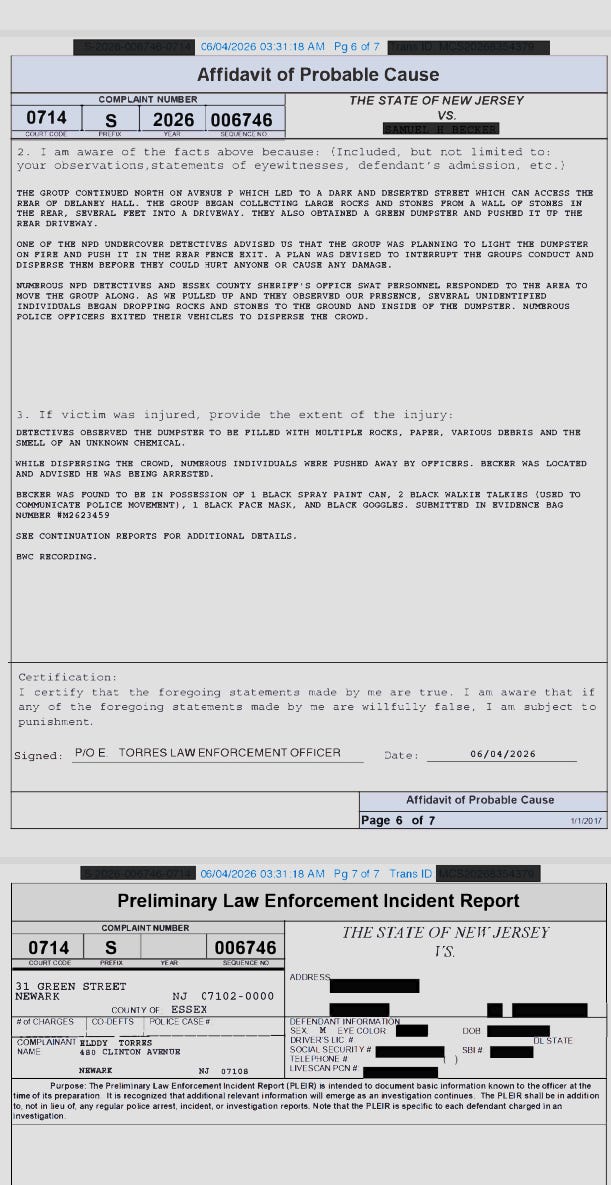
The documents show that Newark Police Department undercover detectives were already embedded within the group as they moved down a deserted street toward Delaney Hall, a private detention center. When the group began discussing a plan to light a dumpster on fire, the embedded officers did not attempt to de-escalate the situation or issue a dispersal warning. Instead, law enforcement monitored the group until the conditions were met for a full tactical deployment, leading to the involvement of the Essex County SWAT team.
Manufacturing Intent and Weaponizing Evidence
The investigation highlights how police deliberately bypassed standard de-escalation protocols. By allowing the situation to progress toward property damage, law enforcement manufactured the legal justification needed for a pre-emptive raid.
Furthermore, the items seized from the suspects (black face masks, black goggles, and consumer-grade walkie-talkies) were rhetorically reframed by prosecutors as a “criminalized operational kit.” These ordinary, legally owned items were used to substantiate severe felony charges, including riot and criminal mischief. By aggressively applying maximum penalties, the state effectively entangles individuals in expensive, time-consuming legal battles, neutralizing their ability to observe or protest.
A Systemic Pattern of Infiltration
The video argues that this incident is not an isolated anomaly but part of a well-documented standard operating procedure. This methodology of state infiltration and subsequent escalation has historical precedents:
COINTELPRO (1970s): Declassified FBI memorandums reveal that federal informants pushed activist groups toward illegal acts to justify large-scale crackdowns.
Montebello Protests (2007): During protests in Canada, masked undercover police were caught operating as agents provocateurs directly inside the demonstration line.
Republican National Convention (2008): State assets embedded in crowds justified aggressive, pre-emptive tactical sweeps by heavily armed riot police.
The Ultimate Goal: Protecting Private Interests
The Newark docket, according to the investigation, perfectly mirrors this historical blueprint. By embedding inside a group and waiting for a pretext, law enforcement weaponizes the concept of intent, transforming public observers into high-level felony suspects.
To understand why these tactics are deployed, the video suggests looking at the location the SWAT team was sent to protect. Delaney Hall is part of a regional network of privately operated detention facilities, which constitutes a massive corporate infrastructure. The primary objective of these embedded operations is rarely about preventing minor property damage, such as a dumpster fire. Instead, the goal is narrative control and mass deterrence.
The law enforcement architecture of entrapment detailed in the video ultimately serves as a protective buffer. By physically clearing the streets and legally preventing organized scrutiny, these tactics shield private, profit-driven detention facilities from democratic transparency and civilian oversight. The “Systemic Pre-emption Model” raises profound questions about the balance between public safety, civil liberties, and the protection of corporate interests by state actors.


