Credit & Support: This report is based on on-the-ground coverage provided by Unicorn Riot, a decentralized, non-profit media organization that exposes the root causes of social and environmental issues. We strongly encourage you to follow their work and support independent journalism. Read the original story here: Unicorn Riot: Indigenous Activists Occupy Land Near Fort Snelling
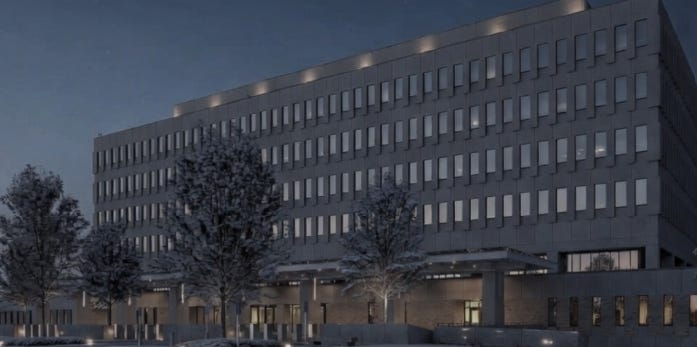
FEBRUARY 12, 2026 — The firelight flickers against the canvas of tipis erected on frozen ground, casting long shadows against the stark, bureaucratic silhouette of the Bishop Henry Whipple Federal Building. To the casual observer, this is a protest. To the Dakota people gathering here, it is a crime scene that has been active for 164 years.
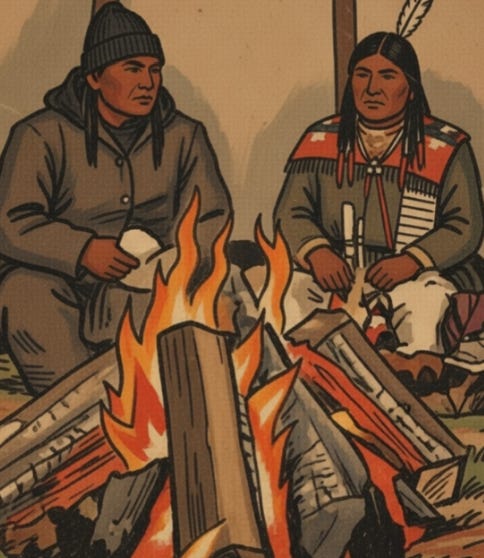
On February 9, 2026, Indigenous activists led by First Nations United reclaimed a patch of land at Coldwater Spring (Mni Owe Sni), establishing an occupation just yards from the headquarters of “Operation Metro Surge”. Their message is hauntingly specific: the atrocities committed against the Dakota people on this soil in 1862 are being reenacted today against migrants inside the federal building next door.
The Occupation: “We Have Not Forgotten”
Under the cover of night, activists set up camp to demand “Land Back“ -specifically the return of the Fort Snelling area and Fort Snelling State Park to the Dakota Oyate people. But this reclamation is also a rescue mission.
Migizi Spears, an organizer with First Nations United, stood before the sacred fire to explain the geography of their resistance. “We’re right over here by the new concentration camp called Henry Whipple,” Spears said, gesturing toward the ICE facility. He drew a direct line to the ground beneath their feet, noting they were occupying the area near where “the old concentration camp area took place here with the Dakotas back in 1862”.
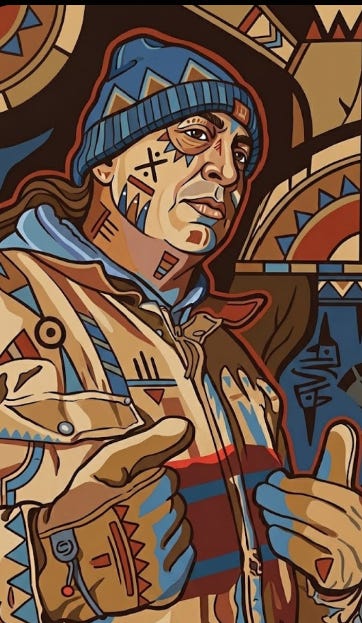
The group is invoking the American Indian Religious Freedom Act of 1978 to practice ceremony on this sacred land, a right they say has been restricted for decades.
The “Old” Atrocity: The Concentration Camp of 1862
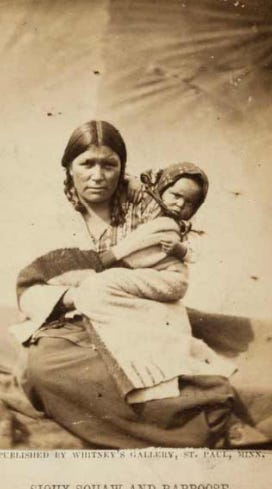
To understand the weight of the phrase “Generation Camp,” one must look at the history of Fort Snelling. Following the U.S.-Dakota War of 1862, the U.S. military forcibly marched approximately 1,700 non-combatant Dakota people—mostly women, children, and elders—to a concentration camp at the fort’s base.
Enclosed by a high wooden stockade on the river bottom, the Dakota were held in brutal conditions throughout the winter of 1862-63. Hundreds died of disease, malnutrition, and exposure before the survivors were loaded onto steamboats and expelled from Minnesota entirely.
“The significance of Fort Snelling is that it was a concentration camp,” said Mike Forcia, Chairman of the American Indian Movement (AIM) Twin Cities, speaking from the occupation. “That’s why the site needs to be turned over to the Dakota people”.
The “New” Atrocity: Operation Metro Surge
The activists argue that the Bishop Henry Whipple Federal Building is simply the modern iteration of that stockade. Since late 2025, the building has served as the command center for “Operation Metro Surge,” a massive federal crackdown that has swept through the Twin Cities.
Inside the Whipple building, detainees—many of whom are Indigenous people from Central and South America—are reportedly held in inhumane conditions. Organizers refer to these migrants as “Southern relatives“ or “Southern natives,” explicitly linking their plight to the Indigenous experience of displacement.
“All the stuff going on with ICE right now has to do with the land and resources,” Forcia explained. “They decide who comes. They decide who leaves... No one should be held at Whipple at all”.
The parallel is stark: On the same riverbank where Dakota families were separated and exiled in 1863, migrant families are being separated and deported in 2026. The technology has changed, but the function of the land—as a site of containment and removal—has not.
The Demands
The occupation is holding space indefinitely until their demands are met. They are calling for:
A Meeting with State Leadership: Activists have demanded that Minnesota Governor Tim Walz and Lieutenant Governor Peggy Flanagan come to the site to “speak to us” directly regarding the transfer of land.
Land Back: The complete return of the Fort Snelling area to the Dakota Oyate.
Tribal Solidarity: Organizers are inviting tribal chairmen, specifically citing Chairman Peter Lengkeek of the Crow Creek Sioux Tribe, to join them and assert their treaty rights.
“We haven’t forgotten about these places,” Spears said, watching the police lights flash nearby. “And we’re coming back to these places”.
Citations: